- Email kavithamuruganspringwood@gmail.com
- Phone 093426 76016
Introduction
Explain why cognitive development matters.
Example you can use:
Children develop important thinking skills during their early years. Researchers and educators have conducted several cognitive experiments to better understand how children learn, think, and solve problems. These studies help teachers and parents create learning environments that support curiosity, creativity, and problem-solving abilities.

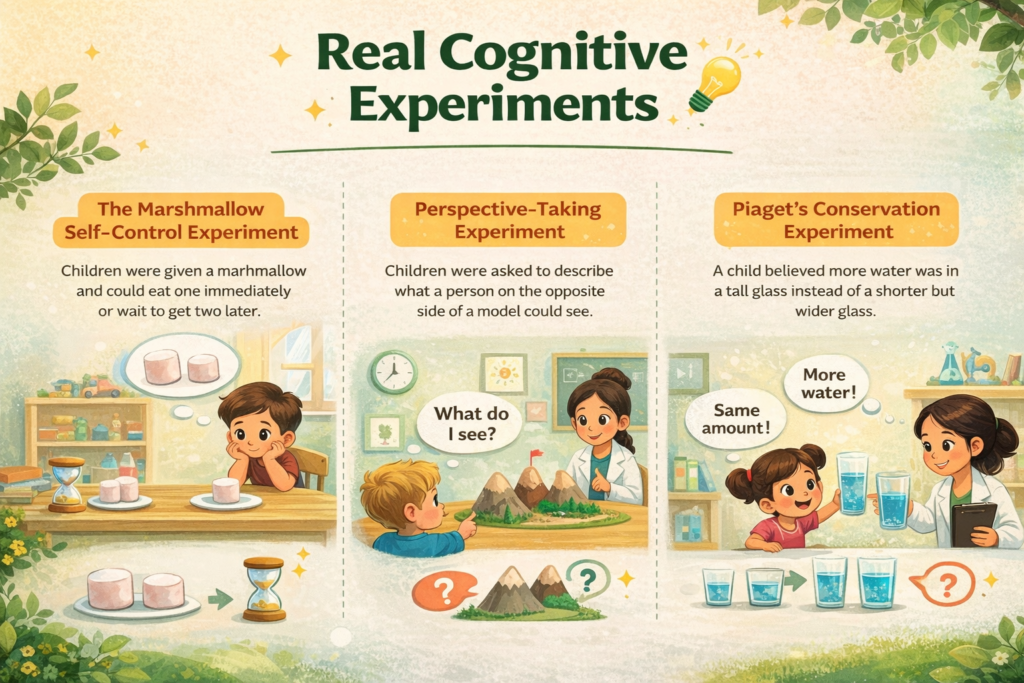
Research by Jean Piaget showed that young children often believe the amount of liquid changes when it is poured into a different-shaped container.
Example experiment:
Two identical glasses contain the same amount of water. When the water from one glass is poured into a taller glass, younger children may think the taller glass has more water.
What it teaches:
Logical thinking develops gradually
Children learn through observation and experience.
2. The Marshmallow Self-Control Experiment
A famous experiment conducted by Walter Mischel at Stanford University studied children’s self-control.
Children were given a marshmallow and told they could eat it immediately or wait for a second marshmallow later.
What it teaches:
Self-control develops in early childhood
Patience and delayed gratification help future success
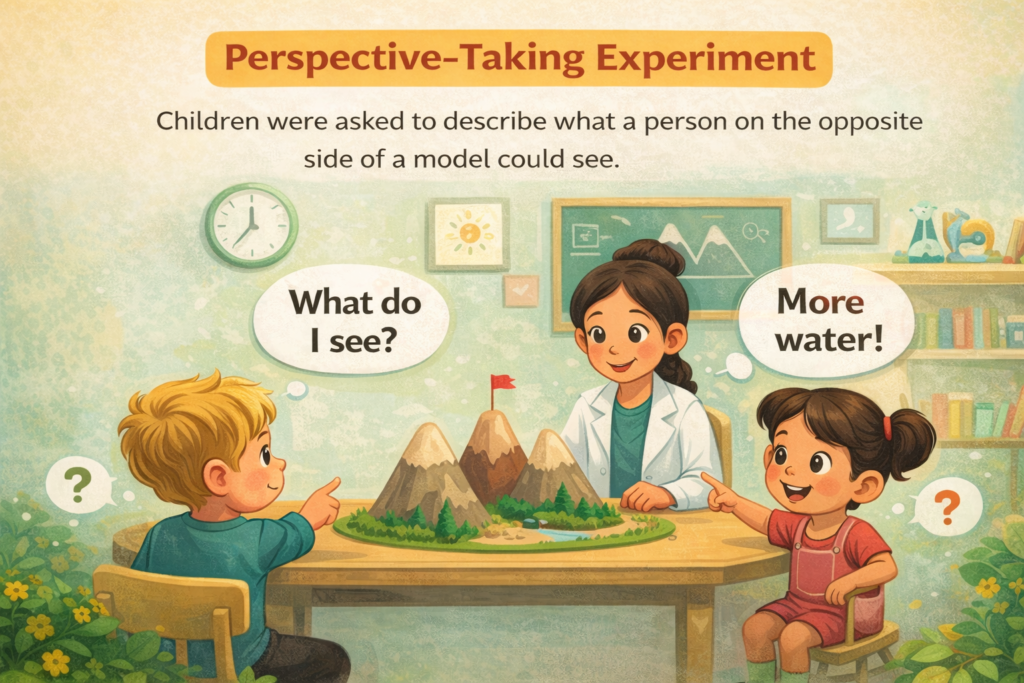

3. Perspective-Taking Experiment
Another experiment by Jean Piaget tested how children understand other people’s viewpoints.
Children were shown a model with mountains and asked what another person on the opposite side could see.
What it teaches:
Young children think from their own perspective
Social understanding grows with age
Research in child psychology shows that play-based learning, problem-solving activities, and hands-on exploration help develop:
Memory
Logical thinking
Creativity
Social understanding
Decision-making skills
Early childhood programs that include interactive learning activities help children build strong cognitive foundations.
Understanding how children think and learn allows educators and parents to support their development more effectively. Research-based learning approaches encourage curiosity, confidence, and critical thinking skills that benefit children throughout their education and daily lives.